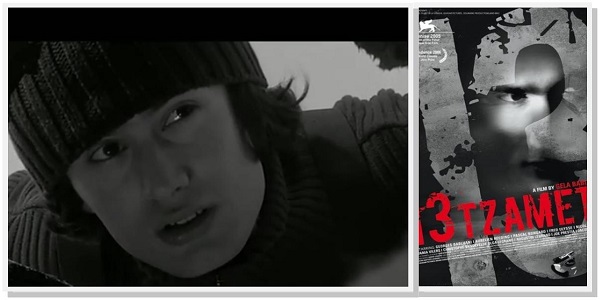
Georgian filmmaker Géla Babluani wrote and directed 13 Tzameti (“Tzameti” also meaning “thirteen” in Georgian) as a dark thriller where the junction of character and the inciting incident is vital to the plot of the story as well as its cinematic impact.
13 Tzameti follows the protagonist Sébastien (Georges Babluani), a young Georgian immigrant in France, who is hired for some roof repair work at a house with its owner Jean François Godon (Philippe Passon) visibly ill. When Godon dies suddenly, Sébastien steals an envelope from the house after Mrs. Godon tells him she has no money to pay him for his work. What he finds inside the envelope leads him to a dark place with money playing dice with human life.
Babluani offers an engaging plot and secures the viewer’s attention by following a single character in a linear Hitchcockian style of storytelling. However, the characters tend to have minimal dialogue and lots of silent staring moments between characters fill this story of a deadly night’s events with the atmosphere of a classic thriller. And more so, because filming in black and white brings the yesteryear feel to the scene.
The question circling this film critic’s assessment is whether 13 Tzameti passes for neo noir. It does have some of the essential thematic and character elements of a classic noir. Sébastien being at the wrong place at the wrong time and falling into the money trap while the nature of his forced crimes clash with the reward he gets over the course of a dark night has the familiar noir quality. Yet the classic film noir atmosphere doesn’t fill the visual space in most of the scenes. Sébastien’s character also doesn’t seem to have the energy, anxiety, and struggle of a noir protagonist.
13 Tzameti makes a good thriller with moments of violence alternating with the dark quiet of the night that parallels the darkness of the characters involved in a deadly game.