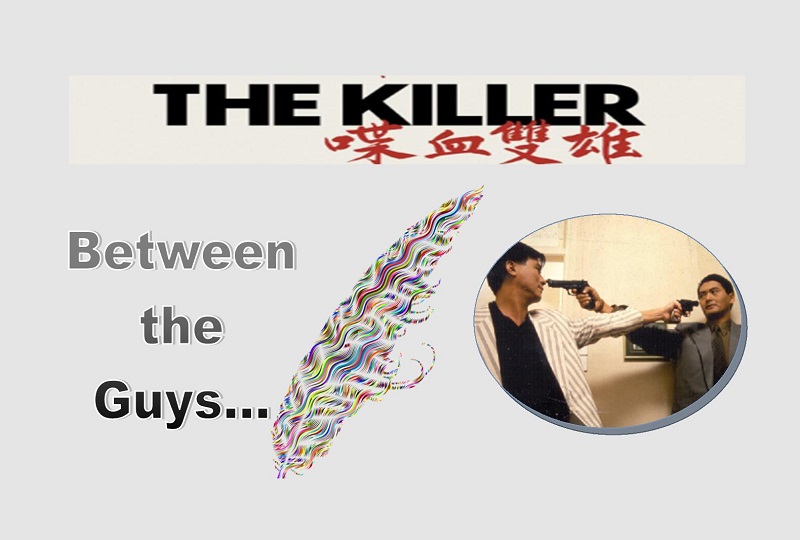
Since watching John Woo’s landmark gangster action film The Killer (1989), I’ve come across quite a few reviews that sense a homoerotic feel to the relationship between the two male leads in the movie: Ah Jong/Jeff (Chow Yun-fat) and Li (Danny Lee). Is it there or have some reviewers gone overboard with their interpretation of the said relationship?
A 2010 LiveJournal review of the movie by retroflex mentioned how some claim these homoerotic overtones are present in Woo’s films and added later in the review that Jeff and Li share a “somewhat homoerotic, but totally not gay bond.” The same vagueness of a homoerotic tension is seen by some other reviewers in various publications with the original claim of its existence going back to two books, both published in 1999: Christopher Heard’s Ten Thousand Bullets: The Cinematic Journey of John Woo and John Woo: The Films by Kenneth E. Hall.
Having read none of these books and seen no actual explanation in the reviews of why the Jeff-Li relationship is homoerotic in nature, my own take on the chemistry of the duo in The Killer is thus strictly my own interpretation more than an analysis of the claim made in those articles. In trying to figure out why the reviewers in question would see a homoerotic chemistry between Jeff and Li, other than repeating the older claim of its existence, it seems that both filmmaking and cultural elements are involved in leading to that interpretation.
On the filmmaking side, there are a number of scenes showing Jeff and Li exchanging looks of admiration, some just silent shots cutting from one to the other. Those are apparently the reason underlying the conclusion of some critics that the duo shares homoerotic chemistry. The other filmmaking side is thematic and seemingly ignored by these critics – namely the spiritual connection between the two men. Each admires the other for breaking the bounds of his respective role – assassin vs cop – for greater good: saving Jenny and stopping the bad actors from doing more harm. Eli Brau’s article in Cinephile Corner discusses the symbolism employed by Woo to convey this connection. What’s notable in Brau’s take is the absence of any mention of homoerotic chemistry between Jeff and Li.
My take on the Jeff-Li relationship is the same as Brau’s with the addition of the cultural angle in mind. In the western societies, particularly in the past couple of decades, homoeroticism has been increasingly brought to the screen as part of an LGBT-empowerment movement. Western critics have been led to see such chemistry between characters where it is not obvious or even present at all. A shot-reverse shot scene of guys staring at each other in admiration to a western reviewer may seem a silent declaration of male-male attraction. But in eastern traditions, Indian and Asian, it is frequently a platonic bond more along brotherly friendship than homoerotic tension. And it goes beyond just staring in gratitude and admiration – hugging, patting, holding one another’s face in both hands, and non-romantic kissing in a display of fraternal affection, all part of it.
John Woo has been cited responding to the question of the perceived homoerotic chemistry of Jeff-Li:
People will bring their own preconceptions to a movie. If they see something in The Killer that they consider to be homoerotic, then that is their privilege. It’s certainly not intentional.
Woo is clear on how he sees it and how we were supposed to see it. Instead of seeing homoeroticism in it, viewing it as homosocial makes more sense in the cultural sense – in other words, it’s just good old Asian bromance. For those born yesterday (like me), “bromance” per wordnik means: “A close but non-sexual relationship between two men, a form of homosocial intimacy.”