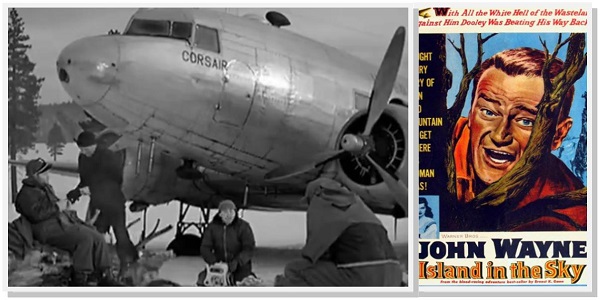
It’s a John Wayne film but you don’t see him in cowboy pants and hat with a gun around his waist and a whip in his hand while he leads a search party or defends a town in the wild west. Instead, he plays the most vulnerable role of his career in William Wellman’s survival adventure feature Island in the Sky (1953).
The adaptation of Ernest K. Gann’s novel of the same title, Island in the Sky takes viewers to the aviation scene of the World War II years when radio communication was man’s best bet on survival against unforeseen disasters. Wayne plays John Dooley, the pilot of a small plane carrying war supplies to England along with four men. As the plane is forced into crash landing over a frozen lake in Canada, Dooley faces the challenge of protecting his men while struggling to keep his own morale steady.
Wayne’s character as the protagonist bags most of the attention both from the filmmaking and the audience’s sides. The monologues of soliloquy, played as voiceover, build the layer of his internal conflict while his commanding persona keeps his juniors up against the deadly cold in the wild. The emotional vulnerability of Dooley is thus accessible to the audience but kept from the other characters around him.
Island in the Sky gains from the realism it offers in avoidance of exaggeration in character and dialogue. The crank radio technology for communication in the old days contributes to the feel of vulnerability that is a key part of adventure tales. The screen time for the characters stranded in the snow could actually have been longer to make it a more intense battle for survival. It appears the director decided to give more credit to the rescue team as we see them planning their strategy at the base and then making the next attempt to locate Dooley and his men.
To have a dose of the spirit of survival adventure and a different taste of the Duke’s lead in the wild, Island in the Sky remains worthy of one’s time.