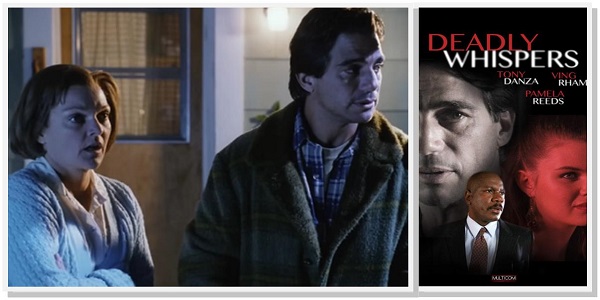
The 1987 murder of teenage Kathy Bonney in Virginia was dramatized for the screen into the TV movie Deadly Whispers (1995) written by Ted Schwarz and Dennis Turner, and directed by Bill Norton. The movie is notable for several reasons, mainly for presenting an issue that would be featured years later in James Mangold’s psychological thriller Identity (2003).
Replacing the last name “Bonney” of the real-life family involved with “Acton,” the movie shows the disappearance of Kathy and the father Tom (Tony Danza), a salvage yard dealer, reporting that he had sent her to meet a customer at a store. The devastated mother, Carol (Pamela Reed), assists in the investigation while struggling to shield her family from the impact. When Kathy’s dead body is discovered, the mystery deepens as Tom’s story starts to fall apart and makes Carol worry about her remaining children’s safety.
Deadly Whispers keeps the mystery of the murder until the climactic reveal of Tom’s mental disorder and lets the conflict play in the audience’s mind, mainly steered through Carol’s viewpoint. The sequences in the plot are edited toward a tragic drama with a somber mood instead of a sensational whodunit mystery. Carol’s character takes the center stage in furthering the story of the family, its protection, and future.
The realistic feel of the movie owes to all departments and Tony Donza gets the credit for delivering in his role. But it’s Pamela Reed who really steals the show with her incredibly genuine and convincing performance as the embattled wife and mother. Reed’s acting talent lives up to the range and depth of the emotions of her character.
Seeing Deadly Whispers as a mystery, it’s notably interesting that in the real-life case Thomas Bonney’s insanity plea was not corroborated by psychiatrists some of whom did agree that he indeed had symptoms of dissociative identity disorder. The question was and remains: was the troubled and tortured child identity in charge of his actions when he did it? The movie lets the mystery live.