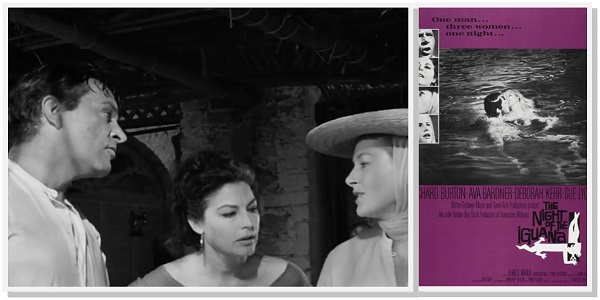
Filming Richard Burton, still young enough, among a bunch of women of all ages and intentions would be the selling point of this movie if it weren’t the adaptation of the celebrated Tennessee Williams’ acclaimed 1961 play “The Night of the Iguana.”
Directed by John Huston, off his screenplay co-written with Anthony Veiller, the movie opens with the transition of Lawrence Shannon (Burton) from a defrocked clergyman to a tour guide. The story then features the events of a tour on which he takes a group of Baptist women to Mexico. During the trip he has significant interactions with four women: 16-year-old Charlotte (Sue Lyon), her chaperone Judith (Grayson Hall), his admirer Maxine (Ava Gardner), and an artist Hannah (Deborah Kerr).
Williams’ plays go deep into the characters and Huston makes good on the power of the camera’s eye to unfold these characters in a somewhat ritualistic fashion. The women approach him in turns and bring out in him a side of his personality, revealing their own characters in these interactions. The plot thus moves by an interesting rhythm of this woman-vs-Shannon through most of the movie.
Huston’s The Night of the Iguana explores the issues of gender-specific morals, sexuality, reputation, and man’s conscience. The motif of letting go recurs throughout the story. What happens to the iguanas happen to men, or can happen, so life’s value for people as creatures of nature is revisited in a Mexican seaside setting.
Back to the selling points: despite the richness of characters, depth of the subject matter, and some really great lines, the movie’s trailer and IMDb poster seem to have picked the few steamy scenes (by the standards back then) in the two plus hours of this adaptation. For curious viewers, don’t be misled by these glimpses of the movie. There is much more than skin in the body of this animal.