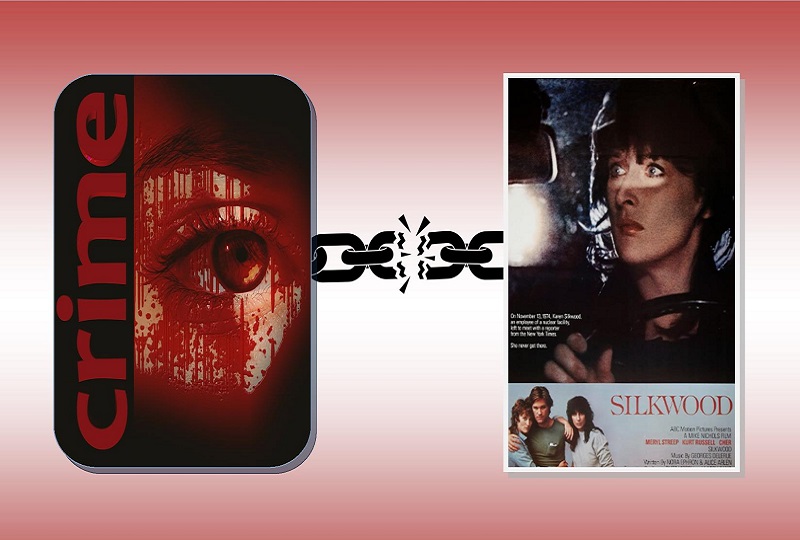
You can see it but you can’t say it. This interesting restrainer works in viewing Mike Nichols’ Silkwood (1983), which is based on a true story.
The movie documents what happened to lab technician Karen Silkwood (played by Meryl Streep) as a worker at the Kerr-McGee Cimarron Fuel Fabrication Site in Crescent, Oklahoma, in the early to mid ‘70s. Witnessing repeated violations of the safety standards at the nuclear fuel processing plant, Karen decided to hold her employer responsible. Before long, she died in a car crash under suspicious circumstances. So does it make Silkwood a true crime film?
The question arises in the mind of the curious viewer who has checked out the movie’s pages on database sites like IMDb. Silkwood is categorized as Drama and Biopic, which is quite accurate. The movie highlights the challenges Karen faces at her workplace and in her personal life as a mother of three young kids with her ex-husband and now living with her boyfriend (Kurt Russell) and a lesbian co-worker Dolly (Cher), who also happens to be her best female friend.
The dominating part of the story, however, is Karen’s workplace experiences of dangerous exposure to plutonium and her decision to confront her employer over their safety failures. Being a union activist, she raises the safety issue and testifies before the Atomic Energy Commission. The plant’s management sees her activism as a threat to their operation. The conflict reaches its peak as Karen arranges to meet with a journalist from the New York Times to give him documented evidence of the management’s safety violations. and the cover-up. But she doesn’t make it to the meeting; the deadly crash ends her life while she is on her way to meet the journalist.
In this story, as presented on the screen, Silkwood walks a tightrope between true crime and drama. The narration proceeds from Karen’s perspective and the movie makes the case for a perceived crime through the eyes of the eponymous protagonist. Aside from the intentional and ongoing cover-up of the safety standard violations by the management, the crime of Karen’s potential murder is perceived directly by the audience. Nichols denies both Karen and the viewer a conclusive verdict on either perception of crime. Karen’s death in real life is shown as it is documented in articles without any details of how the crash happened. Karen’s paranoid look in the car’s interior shot preceding the transition to the crashed car leaves it entirely to the viewer’s imagination to rule whether it was an accident or murder.
For the crime of safety violations cover-up, it’s worth reading the details of the aftermath of Karen’s death. Her family’s lawsuit against Kerr-McGee, the corporation that owned the fuel processing plant where Karen worked, eventually resulted in an out-of-court settlement with over a million dollars paid to Karen’s family but Kerr-McGee admitting no liability – an interesting case of admitting something without admitting it. Officially, still not a crime!
As for the official cause of Karen’s death, it was simply an accident resulting from her falling asleep at the wheel under the influence of prescription drugs. In other words, no foul play – even when many found it not a credible conclusion in real life.
Silkwood is not “officially” a true crime movie but viewers can see and believe it as a real life crime story. They may or may not win the argument but they sure have a case for such an argument.