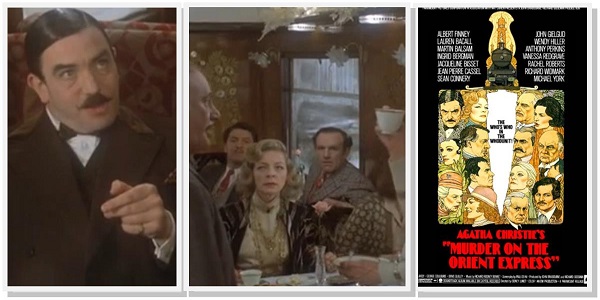
The 1974 adaptation of Agatha Christie’s classic mystery novel Murder on the Orient Express, directed by Sidney Lumet, is remembered for being a star-studded feature and a big success at the box office. Paul Dehn and Anthony Shaffer created the screenplay off Christie’s novel and Lumet turned it into a charm on the big screen for mystery lovers.
The title gives away the setting – the train called Orient Express – where a murder takes place while Christie’s legendary private eye Hercule Poirot is onboard. While the train is stranded in Yugoslavia due to a snowdrift, Poirot interviews nearly a dozen passengers any of whom could be the killer – or maybe one of the killers.
Murder on the Orient Express sits on the cozy side of the mystery bench aside from a few mildly violent details that are not visually used as shockers by Lumet in his adaptation. The setting plays a key role in this effect. Most of the interrogation scenes not only observe social rules of civility but take place in the comfort of the well-furnished train car, many of them at the dining tables. The cold of the white snow and dark depictions of the gruesome murder are both expelled from the audience’s view.
Albert Finny’s look and accent are expertly transformed to create a very Belgian Poirot who is mistaken for being French – and understandably so. The rest of the cast includes acting icons – Lauren Bacall, Martin Balsam, Ingrid Bergman, Sean Connery, Anthony Perkins, Vanessa Redgrave, and others. Expect to see most in exceptionally Europeanized getups of the period and speaking with unique accents.
Revealing the murderer at the end and the mechanics of the crime aren’t the climax of a mystery; it’s the connection to the murder and the motivation of the murderer, particularly in cozy mysteries. Lumet’s Murder on the Orient Express delivers that part with artistic skill. This is a movie to enjoy on a cold evening or, ideally, on a train ride through snowy weather.
Note: This reviewer has not read Agatha Christie’s novel, which is the basis for this movie; hence no assessment of the movie in context of the book.