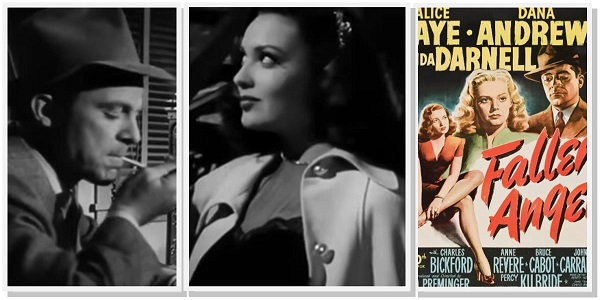
Otto Preminger’s Fallen Angel came out a year after Laura and shares its twist in the mystery though not exactly in the status of the femme fatale character, and the same actor playing the protagonist – Dana Andrews.
The prime suspect in Fallen Angel is Eric Stanton (Dana Andrews) who drops into a small town because he has no money to continue onward to San Francisco. In the town he meets the seductive waitress Stella (Linda Darnell) who won’t commit to marrying him until he can show her he is worth it. So Stanton comes up with a plan and it doesn’t go as he had hoped.
In Fallen Angel, Preminger delivers on making the chemistry between the drifter and the femme fatale come live to a fair level of intensity, quite rough and tumultuous. It doesn’t get to a climactic ending though and despite our big reveal at the end, the story falls a prey to more telling than showing – no spoilers intended so leaving it here (for those who still haven’t seen the movie).
Of the ending itself, Fallen Angel brings up the question of a happy ending in a noir. Some argue it takes away from the true spirit of noir particularly when the main character goes entirely unscathed and the system – law enforcement – happens to work. June (Alice Faye) as a foil for Stella seems an okay choice though one can question her unsuspecting nature despite her trusted sister Clara (Anne Revere) warning her and every circumstance pointing to it. Fairytale stuff can be made part of a noir but can appear out of place and affect the movie’s impact.
Along with Linda Darnell’s acting, the best part of Fallen Angel as a noir is cinematography. The lighting for most scenes and several two-shots featuring different characters give the air a feel of hidden intensions. The title of the movie isn’t very fitting but no suggestions offered here.