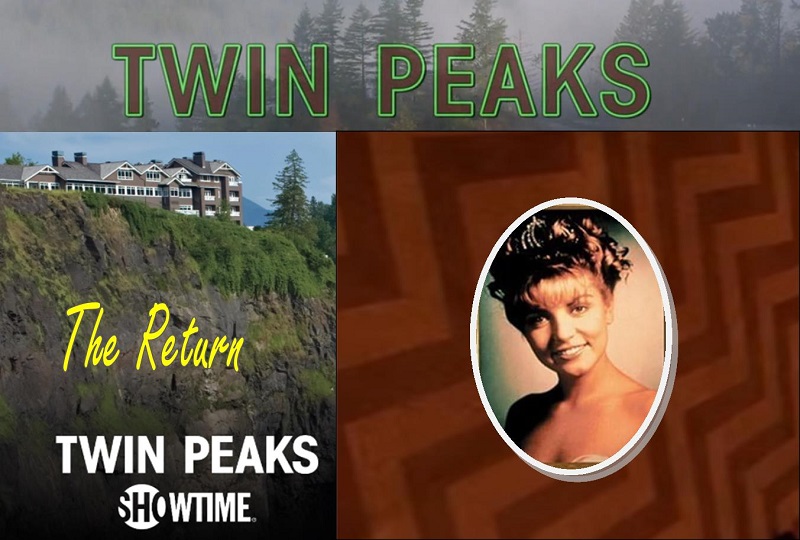
David Lynch’s first death anniversary was observed last month with lots of praise showered on his works, notably his last regular feature production Twin Peaks: The Return (2017), supposed to be the 3rd season of Lynch and Mark Frost’s landmark TV show Twin Peaks (1989 – 91). Social media posts from accounts named after the show and Lynch went as far as calling The Return better than the original show.
As a fan of the original Twin Peaks (which ran 2 seasons) and Lynch’s work in general, I offered my two cents briefly in 2020 as to why The Return wasn’t Twin Peaks anymore and should have been called something else. Quoting myself from the blog:
What The Return obviously is not is Twin Peaks. It’s more a spin-off that should have been called something else. Calling it Twin Peaks is misleading.
It’s worth returning to that thought and adding to it in response to the recent threads of appraisement that find it Lynch’s magnum opus or masterpiece. Offering my assessment strictly in the context of its categorization as the third season of Twin Peaks, I beg to differ. While there can literally be entire volumes of a book written about the topic, my conclusive statement is a question: in Twin Peaks: The Return, what exactly did the viewers of the original show return to? The answer on my end is: not to Twin Peaks.
The original show by Lynch and Frost is a mystery of many things, all stemming from one shocking incident – the murder of 17-year-old Laura Palmer. Who did it and why? This question spawns the different subplots associated with various characters in the town as FBI Agent Dale Cooper investigates Laura’s murder in collaboration with the local sheriff Harry Truman’s office. The story of the show stood on two foundations – the town (setting) and its people (characters including Cooper, who is technically a visitor/outsider). Lose grip on any of these foundations and the story goes humpty dumpty. And that is exactly what happened in The Return.
In 1991, the show left its audience at Twin Peaks, the town where Cooper was possessed by the evil entity personified as Bob. Lightheartedly, it probably was his punishment for not leaving the town despite having long solved Laura’s murder mystery. But accommodating all the subplots tossed in there for the second season, Cooper’s continued presence in town was tolerable. Those subplots, again, were the stories of unresolved conflicts of Twin Peakers – the foundation of the show. When viewers returned to see The Return in 2017, most of those stories and many of those people did not return. Donna – the actual heroine of the story – was entirely dropped to the point of no-mention. Harry, the second lead of the show after Cooper was cursorily mentioned as unwell and dropped. James – the supposed hero of the story among townsfolk – was brought back in name only and other characters like Bobby, Shelly, Norma, Audrey etc. all were treated as secondary, if not less. Their stories were shrunk to a line or two in passing, and left at that.
These characters were sacrificed because the show chose the outsider Cooper as its new focus. Instead of Twin Peaks, The Return became Cooper’s story, splitting his character and following his multiple versions either directly or in connection with other subplots scattered about the place. One key foundation of the original show – the characters – was recklessly dumped.
What happened to the second foundation – the setting of small town America – is no better. In pursuit of the multiple Coopers and new subplots, the story was moved out of the titular town and thrown all over the country: New York, Las Vegas, South Dakota, Texas, and in between. The most important character of the show – the town of Twin Peaks – was virtually discarded. This new presentation could not be Twin Peaks; it never can be Twin Peaks. Seemingly, the makers of the show didn’t see much use for the town now that they had switched gears on the plotlines. Yet, to keep the show’s loyal fans onboard, the new series was named Twin Peaks and its main intro visuals and music were kept in place. Packing the series with different paranormal events and thus adding layers of mystery only to loosely connect it to the Black Lodge and the Sheriff’s Office in the town didn’t bring even a slice of magic that the original show has enjoyed for two seasons.
Then in the final few episodes, The Return did the unthinkable. After forgetting about Laura Palmer for most of the series, it abruptly decided to bring her back, alive. To convey that whatever the viewers had watched 25 years ago really didn’t happen, one quick scene amateurishly showed Laura’s dead body disappearing from the site where it was discovered in the first episode. The entire fabric of the original story was undone with one cartoonish stroke. It was The Return officially cancelling Twin Peaks. It’s almost funny to think that the Lynch-Frost team decided to do it as it pulls the rug from under the The Return as well. If Laura never died, Cooper was never assigned the case; he never visited Twin Peaks; was never possessed either; and all that we saw and are seeing never happened. So what are we watching here?
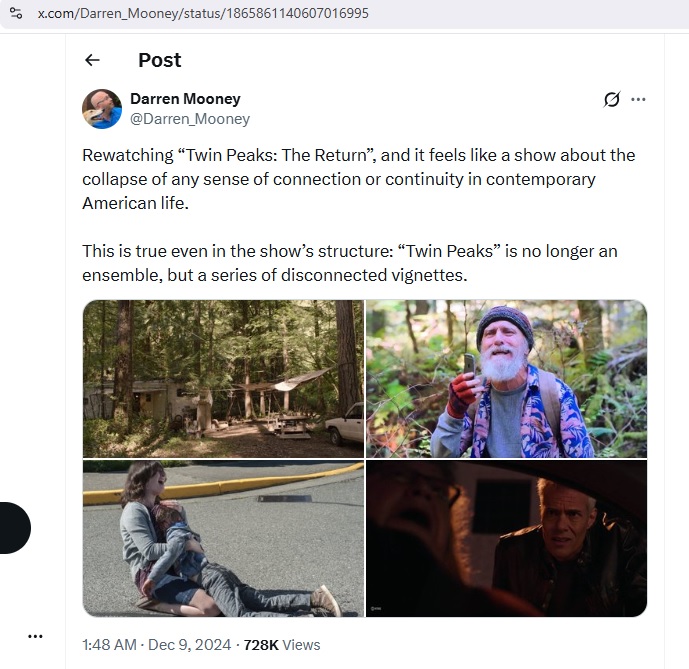
The Return was by no means the return of Twin Peaks. It is fairly obvious that Lynch (with or without Frost) decided to relive his celebrated works and reunite with his wonderful cast from his various productions. So instead of creating a new story that would smoothly fit into the existing one, they put some old and some new plots and settings together and ran the production mixer to whip it all into whatever product it created. It didn’t mix harmoniously. It couldn’t. The result was a fragmented show that carried bits and pieces of different works. Darren Mooney put it well in his X post about The Return:
It is interesting to note that on IMDb, the follow-up show is listed as its own series with 18 episodes despite its misleading title of” Twin Peaks” and not as the third season of the original show. I like it that way since the story of Twin Peaks ended with its prequel in Fire Walk with Me (1992). It would not return.