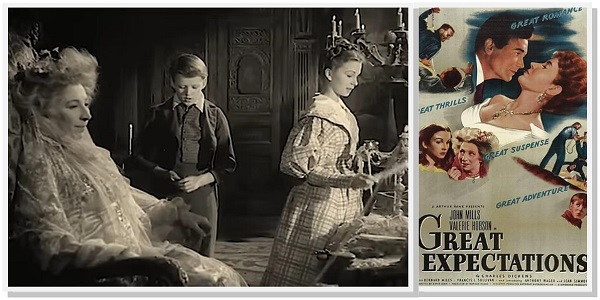
One of the early feature film adaptations of Charles Dickens’ classic novel Great Expectations, the 1946 movie was directed by David Lean, who also co-wrote the screenplay with Ronald Neame. With a British main cast, Lean’s adaptation delivers in some elements while falls short of brilliance on the whole.
The celebrated novel’s all too familiar plot follows the life journey of young pip, who lives with his sister and her husband Joe, a blacksmith, by the marshes. From the first encounter with the escaped convict Abel Magwitch to his time spent at the bleak mansion of Miss Havisham and then going to London as a young man only to have his heart broken time and again, Pip’s coming-of-age story is an adventure and a tragedy going hand in hand.
Lean’s Great Expectations can be appreciated for its work on the setting and costumes. Perhaps recreating the visual world of the Victorian period was less of a challenge still in the 1940s than in the decades to follow. John Mills as grown-up Pip, Valerie Hobson as Estella (grown-up), Bernard Miles as Joe Gargery, and other actors did a decent job in their respective characters.
But the main issue with Lean’s adaptation is its failure to stay loyal to the original story of the novel, mainly by exclusion as well as alteration of some really important details that fans of the novel would find hard to ignore. The death of Pip’s sister, Pip’s interaction with Biddy and his decision to propose to her, and the ending scene are some of the most unfaithful representations of the novel’s details.
The movie’s tone and editing also fail to recreate the emotional atmosphere of the novel. If a comparison was sought, the 1989 TV series directed by Kevin Connor with Anthony Calf as Pip, Anthony Hopkins as Magwitch, and Kim Thomson as Estella makes a much better adaptation of the novel for screen. Interestingly, Jean Simmons who played young Estella in Lean’s adaptation played Miss Havisham in the series, and nailed the role. How time flies!