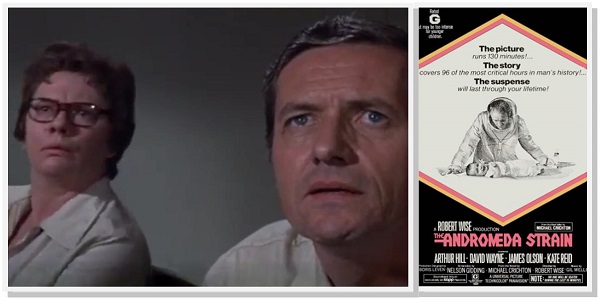
Robert Wise wasn’t just directing another potential pathogen disaster movie in The Andromeda Strain (1971); he was taking incorporation of scientific realism into a trending sci-fi storyline based off Michael Crichton’s novel of the same name to another level in two plus hours of this feature.
The story crash lands into a start with the fall of a government satellite in a small town and causing the mysterious mass casualty of all its inhabitants except an alcoholic and an infant. To defuse the potential contagion catastrophe, a team of experts in the biology/medical field, led by Dr. Jeremy Stone (Arthur Hill) and Dr. Mark Hall (James Olson), are assigned the investigation at a secret government-controlled underground facility. What they uncover would determine the future of life on earth.
They say the devil is in the details; in The Andromeda Strain, the filmmakers took this aphorism to apply the effects of extended procedural depictions in a scientific setting on the movie’s plot and character. The most outstanding of these effects is credibility. For s sci-fi to offer such details without hasty pursuit of sensational plot twists and turns, the audience is left with little choice but be impressed with the presentation.
Wise’s The Andromeda Strain takes its time to grab the viewer’s attention with plot points and generate a climax in the story without any overreaction of the characters. The touch of professionalism leads all the departments of this movie both off and on camera. All members of the investigation team get their fair screen time but Hall emerges as the real hero for his role in the climax sequence. One notable observation in this movie is the lack of inter-personal conflict among characters – which ties well into the emphasis on professionalism in an emergency situation – which stands in contrast to many other movies in the genre.
The Andromeda Strain is significant and relevant to watch today as a slice of sci-fi excellence in the ‘70s.