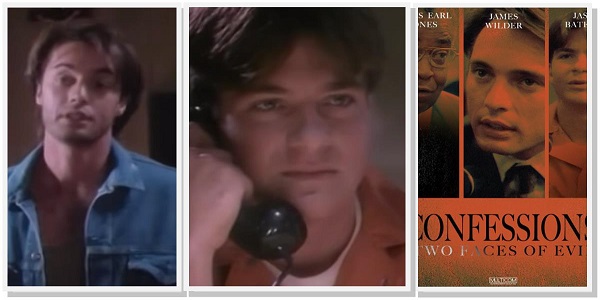
One of the most interesting and mind-boggling crimes that made news back in the ’80s is featured in the TV movie Confessions: Two Faces of Evil (1994). Written by Gy Waldron and directed by Gilbert Cates, the movie shows how the law enforcement in California handled the strange case of the killing of a police officer with two suspects living across state lines.
The story starts with the killing of a San Fernando cop named Dennis Webb (Blake Boyd) on Christmas Eve in 1980 when he intercepts a burglary suspect on a street. The suspect shoots him six times and escapes in the officer’s police car. Soon the law enforcement learns that a young man in Oklahoma, named Robert Berndt (James Wilder), with a criminal record has confessed to killing Officer Webb. But before they can prosecute Berndt, a college student in New Mexico named Bill Motorshed (Jason Bateman) also confesses to killing Webb. Who, if not both, of these suspects is lying and for what reason?
Confessions moves efficiently through the police procedural plot that rides the fence between a drama and a crime thriller. The key moments in the official investigation, prosecution, and trial of the suspects are sorted well and in good chronological order to keep the viewer engaged. At the same time, the movie employs flashbacks at the right spots to reveal the psychological profiles of Berndt and Motorshed, making the case more dramatic with depth of character.
Like the puzzle of dual confessions in the movie, the main hook for the audience is also two-fold: who did it and why is the one who didn’t do it lying? Confessions succeeds in showing the hidden psychological urges that drive one to crime and the burden of law enforcement to act responsibly in pursuing the investigation of a crime. For true crime fans, this movie is highly recommended.