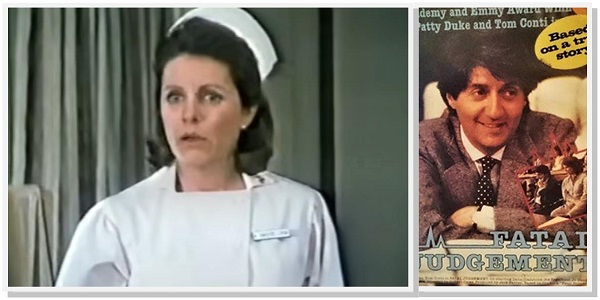
True crime stories typically involve the pain or harm inflicted on a victim by an offender. But there are cases when the question of concern isn’t who committed a crime against whom; rather it’s whether a crime was committed in the first place. Such is the story of Anne Capute as dramatized in the 1988 TV movie Fatal Judgement.
Capute (played by Patty Duke), a Massachusetts nurse, was found to have administered excess doses of morphine to help relieve the pain of a terminally diagnosed cancer patient but not without the permission of the doctor in charge of the case. Charged with murder of the patient, Capute finds herself in a fight for proving her innocence as well as defending her sanity against mounting stress under which she fears her family life crumbling before her eyes.
The question of the determination of a crime depending on the accused’s knowledge and intent makes Fatal Judgement a must-see movie in our times when medical malpractice is increasingly becoming a concern for individuals and families. The movie focuses on Capute’s indictment and trial parallel to her familial situation where she has to keep her roles of wife and mother as much protected from the fallout of her workplace quandary as possible.
The real life story has more to say about Capute’s background, something that is related to the death case of the patient for which she was indicted. Fatal Judgement includes the note that her nursing license was revoked for four years before she got it restored. In fact, Capute admitted to not having a high school diploma, which would have made her ineligible to be trained as a nurse. But she had passed her nursing exams successfully and become a good nurse.
In the long list of good old TV movies that highlighted important questions, Fatal Judgement shines a light on human vulnerability and the razor-sharp divide between compassion and crime in medical and caregiving settings.